This southern winter, SSP revisits the two deserts which provided the early inspiration for our outreach programme.
In June, we are back among the red sand ridges of the Simpson, joining the Outback Camel Co. and Australian Desert Expeditions, led by explorer Andrew Harper OAM FRGS. This year, the Simpson west of Birdsville will be awash with plant life following substantial summer rain and flooding throughout the QLD Channel Country, so our accompanying ecologists anticipate excellent conditions for their fauna and flora surveys.
By day, SSP coordinator Thomas is looking forward to working with a familiar band of camels, and by night rolling out his swag beneath a starry sky, on a quiet claypan beyond the reach of roads and trails.
It has been four years since Thomas first stepped onto those red sands. Unknown to him at the time, this was the early catalyst for an idea that would become SSP.

Looking down from dune crest upon OCC camel strings, western Simpson Desert, June 2022.
In July, SSP attends Spaceward Bound ’25, a planetary science field conference in Ladakh, a Himalayan territory in NW India. SB’25 is organised with great effort and passion by the team at Protoplanet, headed by space systems engineer Dr. Siddharth Pandey. A jam-packed conference programme will see a multi-national band of scientists converge on Ladakh’s high-altitude desert plateau to train the next generation of planetary geologists and astrobiologists. The programme is centred around field sites at Tso Kar salt lake system and Puga geothermal springs, concluding with a visit to the University of Ladakh.
The region’s fascinating terrain features a plethora of Mars analogue sites which, besides their scientific value, hold great potential for training human space explorers and off-Earth systems engineers. To this end, Protoplanet has secured an exciting partnership with the Indian Space Research Organisation Human Space Flight Centre (ISRO HSFC) to advance space habitat design and research. Interested readers can learn more about Ladakh’s Mars analogue potential in this seminal paper: “Ladakh: diverse, high-altitude extreme environments for off-Earth analogue and astrobiology research”, published in the International Journal of Astrobiology in 2019.
Thomas visited Ladakh in 2022 – also for planetary science purposes – which fuelled his growing interest in Mars analogues and led to the development of the Next Desert Mars expedition series to investigate sites in Australia. He quickly fell in love with a dramatic landscape wrought by tectonic forces, peppered by serene gompas atop tranquil ridgelines, and adorned with prayer flags fluttering at high passes; a vast, contemplative land at the intersection of Islamic and Buddhist culture. After the main itinerary concluded, he spent several happy days searching the slopes and plains for their elusive wildlife, culminating in two very special moments observing the giant argali at Tso Kar and goa antelope near the border with Tibet, and wonders if this time around he’ll catch a glimpse of the ghost cat – the enigmatic shan.

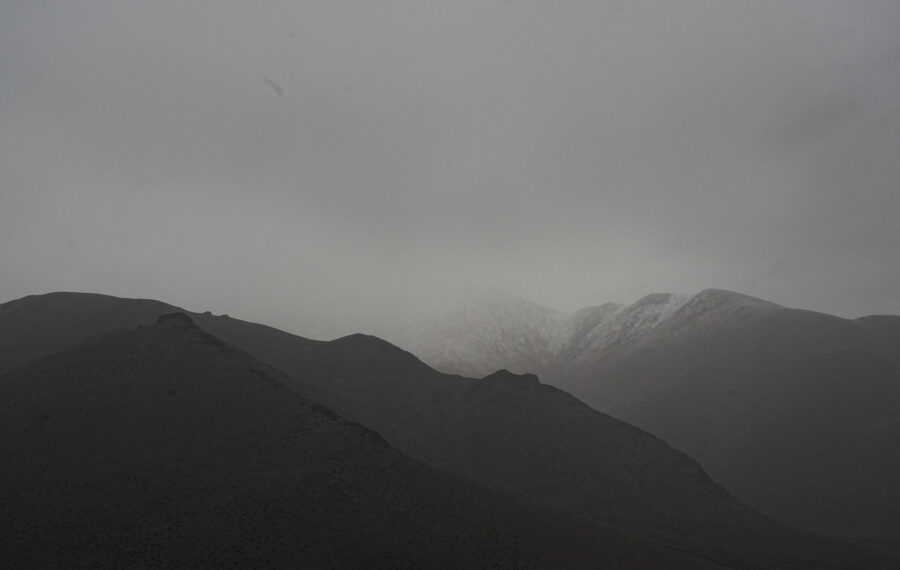
High-altitude, arid landscape in Ladakh.
General update
In the first half of this year, the Southern Skies Project evolved from a cluster of interesting ideas to become an exciting, tangible reality. Our website launched in April alongside our Camel & Hammers expedition patch and Crux logo (thanks to the creative team at Argon for all that!). Now that we’re on secure footing, we have started scouting for project partners, sponsors, and the expedition science & outreach crew. This is our principal focus going into the second half of 2025.
Exciting times ahead! For the next two months, SSP will enter a quiescent phase – expect next communications when we resume project planning in August.
Thank you for your interest and support so far.
Featured image: Hills above Thukje, Tso Kar area, Ladakh.